Friday, January 7, 2011

Street Reflections 301: Cleanliness Next to Godliness

Elizabeth Michelman, Street Reflections 301: Cleanliness Next to Godliness, January 2011

BEVERLY, MA January 2, 2011- Montserrat College of Art Galleries’ Frame 301 is pleased to present Elizabeth Michelman’s Street Reflections 301: Cleanliness Next to Godliness, curated by Lydia Gordon. The kick-off exhibition of 2011, takes a look at downtown Beverly by focusing on the relationship between Frame 301 and two neighbors: a laundromat and church.

Michelman’s site-responsive installation Street Reflections 301: Cleanliness Next to Godliness prompts a questioning of collective relations. By noticing how Frame 301 stands across from a church and a laundromat, the artist wonders how much these pillars of the neighborhood know of and understand each other. These three institutions offer different routes for expressing fundamental values in contemporary American culture: the art school practice, private worship, and personal hygiene. Street Reflections 301 quotes the words of a familiar proverb to capture, meditate on, and reflect these ideas back out to its viewers.

Street Reflections 301 dramatizes the window’s physical characteristics of transparency and reflection, conveying its message through illuminated language best visible at night. The words “cleanliness” and “godliness,” emanate from the window with a projection of inner light and color. By linking elements of each building through the proverb, the artist renews our curiosity with the streetscape and our relationship with the streetscape. The installation implicates Montserrat College as a cultural agent, situated to observe and comment on the disparities between our exterior environment and the inner feeling underlying the everyday needs, purposes, and values of our audience.

Elizabeth Michelman is an interdisciplinary artist exhibiting public and site-responsive installation art, video documentaries and artist’s videos. Her range of media includes sculpture, drawing, painting, poetry, video, and installation. Both as an artist and a curator, she has organized many site-responsive exhibitions and community participatory projects throughout New England. Michelman has taught and lectured on a range of subjects including exhibitions, 2D/3D design, drawing, sculpture, and interdisciplinary art and installation at Mass College of Art and around New England.

Monday, December 13, 2010

Diane Bronstein: underdressed


Montserrat College of Art Gallery is pleased to present Diane Bronstein’s installation, underdressed, curated by Lydia Gordon. The closing exhibition of 2010 in Montserrat College of Art’s alternative display space Frame 301, Bronstein’s arrangement of handmade underwear, bras, and slips suggest a narrative to each article of clothing, hinting at the vulnerability yet desirability of its wearers.


The artist’s creation of intimate apparel derives from her interest in privacy and how we identify ourselves by covering the body. The detailed sketching, clothing design and delicate craftsmanship of each piece allows the artist to explore the closest layer of clothing to our bodies and its protective connotation. By exposing what is usually covered, the artist brings intrigue to each piece, its owner, and their relationship.


A visual and conceptual pastiche, underdressed transforms the storefront gallery into a scene of laundry lines. underdressed is constructed from hand-sewn paper clothing, sketches of figure drawings, and sky-blue paint, drawing connections to the everyday surroundings on Cabot Street. By incorporating elements of the laundromat, art school practice, and skyline, underdressed rearranges physical characteristics of our community. By utilizing the unique perspective Frame 301 offers viewers, Bronstein hangs her pieces in a zig-zag fashion, ultimately proposing a three-dimensional, unconventional looking experience. While the artist’s process involved the layering of pencil, charcoal, and paper, underdressed ultimately strips down to the idea of physical identity, modesty, and desirability. 


Diane Bronstein is a Boston-based artist focused on the creation of paper clothing, inspired by her attendance to life-drawing sessions at the Arlington Center for the Arts . Bronstein received her B.F.A in Graphic Design and Illustration at Carnegie-Mellon University and currently works as an exhibition designer for traveling, temporary and permanent exhibitions at the Museum of Science in Boston. 


For more information: http://montserrat.edu/galleries/frame%20301/


Thursday, October 7, 2010

Yassie Goldie & GJYD's "i want to soX yuO"


October 5 – November 5


Originally a storefront window, Frame 301 was the perfect space for GJYD to launch their most recent campaign, which includes commercials for yuO soX memorabilia that glow from within gold television sets and yuO soX merchandise available for purchase.


With an interest in shedding light on social injustice and promoting change rather than promoting themselves, it was clear that GJYD needed a figurehead. In 2008, this responsibility was given to Mr. Yassy Goldie. The group utilizes Goldie’s public persona for promotion and representation so the individual identities of the collaborative members may remain anonymous. I want to soX you, a campaign inspired by Boston’s beloved baseball team, is Goldie’s attempt at introducing himself to and connecting with the city of Boston.

By way of the internet, social media, guerilla performances and public installations, GJYD have exhibited their “death metal glam ghettotech” aesthetics throughout the regional and digital art communities. The group’s egalitarian street art style and process symbolize their dedication to targeting closed-mindedness, prejudice and hatred through truth, irony, humor and satire in the most public spheres.

Raul Gonzalez: The Gangs all Here, Minus a few featuring El Frijol, El Negrito and the Angel


September 2 – October 4

A Founding member of Somerville art collective Miracle 5, Gonzalez work references histories through the aesthetic of antiquated cartooning. In his most recent work, stereotypical cartoon character archetypes are used to encourage a socio-historical critique.

“The Gangs all here, Minus a Few featuring El Frijol, El Negrito and the Angel” refers to the nicknames used as terms of “endearment” to those with darker or lighter skin tones in the Mexican culture. The characters are fictional and drawn using the same shapes but the colors with which they are painted changes their interpretation. The clouds and the colors distract you from seeing the shape in it's true form.


"Cartoon characters are like water in that they can take any form that we imagine for them as well as survive any treatment. They have been dehumanized and can therefore be tortured and humiliated without any lasting degree of guilt or consequence before disappearing from our memories altogether." - Raul Gonzalez

Karen Moss: The Commuter


August 4th - 30th

The Commuter, an installation by Boston-based artist Karen Moss exhibits her recognizable hybrid characters cavorting through imaginary landscapes. In this site-specific work, Moss' imagery sets up a comparison of the urban and the bucolic. Both scenes merge retro aesthetics with the characteristics of contemporary street art to depict the experience of popular culture in both metropolitan and rural environments.

Meltdown


June 1st - July 5th


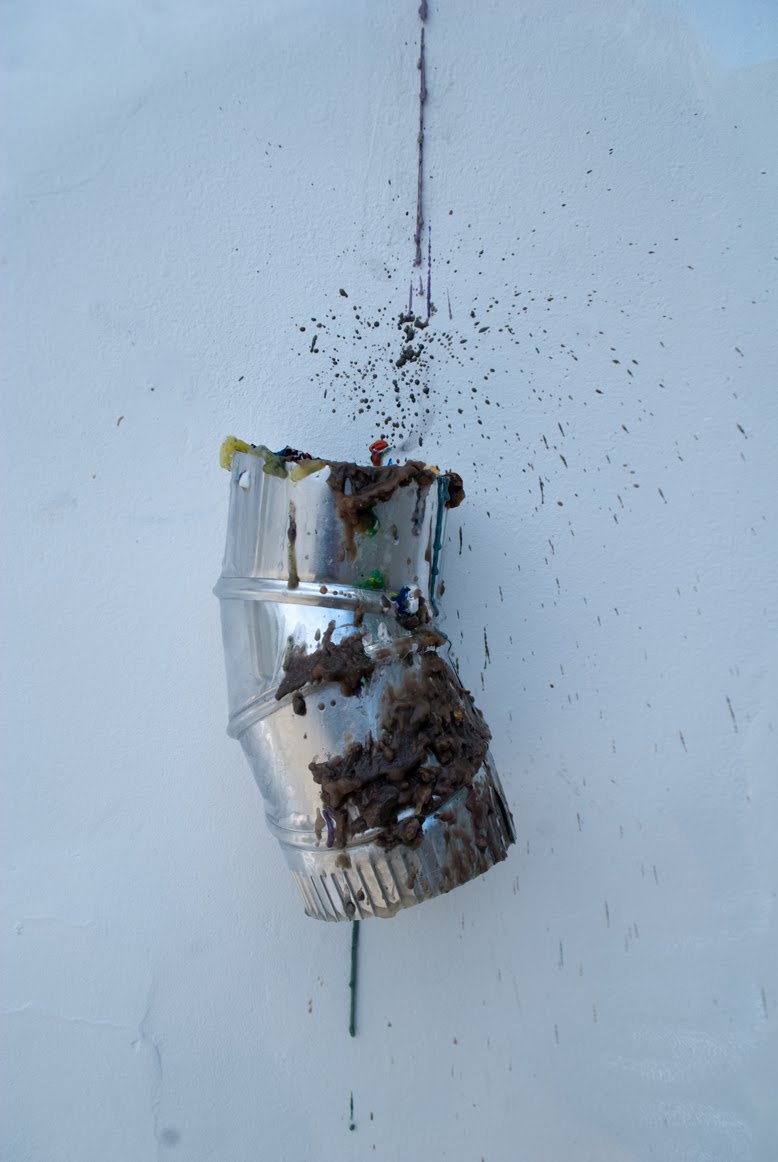
As Part of 2010 annual Encaustic Conference, wax scraps were collected from attendees and installed in Frame 301.

Wednesday, March 31, 2010

Brandy Wolfe - "Stuffed"


Stuffed, Boston-based arist Brandy Wolfe's installation is in our space until April 6th. The installation includes family photos the artist found from the 1930’s to the 1950’s. They are accompanied by her own sewn stuffed animals that mimic the memories shown in the photographs.

Wolfe’s exhibit focuses on the connection between individual memories with specific material objects. The piece began with Wolfe purchasing displaced family photographs from online auctions, focusing on those that depicted children with stuffed toys. By recreating the inanimate characters from these photographs, pinning some on the wall and letting the others pile up below, she has put on display a dissection of these memories and alluded to the difficulty of actually recreating them. Like the displays in a natural history museum, Wolfe’s piece reflects the malleability of collective memory.

(Wolfe now residing in Brighton, MA has been featured in many exhibits throughout the U.S. She received her BFA in Painting from the Maryland Institute College of Art and Masters in Art History from Ohio State University. Wolfe has recently exhibited her work at the MCLA Gallery 51 in North Adams, MA, KSpace Contemporary in Corpus Christie, TX, the Atlantic Works Gallery in Boston, MA and will be installing work in the group exhibition Yellow at the Boston Children’s Museum this year.)